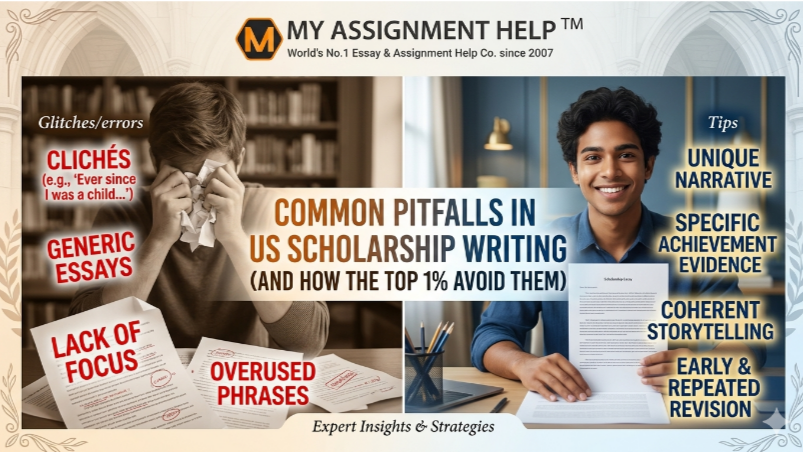
Common Pitfalls in US Scholarship Writing (And How the Top 1% Avoid Them)
In the hyper-competitive landscape of American higher education, a scholarship essay is often the only bridge between a student’s academic aspirations and the soaring costs of tuition. With the average cost of attendance at a private four-year college reaching approximately $60,000 annually, the stakes have never been higher. Yet, every year, thousands of brilliant students see their applications rejected—not because they lack merit, but because they fall into predictable rhetorical traps.
The “Top 1%” of applicants—those who consistently secure funding from prestigious programs like the Fulbright, Gates Millennium, or Coca-Cola Scholars—don’t just write better; they think differently. They view the essay as a strategic branding document rather than a simple creative writing exercise. They understand that while a GPA gets you into the room, it is the narrative that secures the check.
Navigating these nuances can be daunting, especially when trying to balance personality with professionalism. Many students find that utilizing a professional scholarship essay writing service allows them to refine their unique voice while ensuring their application meets the rigorous standards expected by US scholarship committees. By understanding the common pitfalls that sink most applications, you can pivot your strategy to align with what evaluators are actually looking for.
1. The “Resumé in Prose” Trap
One of the most frequent mistakes is treating the essay as a chronological retelling of one’s CV. Committees have already seen your list of extracurriculars and your transcript.
- The Pitfall: Listing every achievement from the 9th grade onwards without depth.
- The 1% Strategy: They choose one or two “defining moments” and use a microscopic lens to explore them. This creates a “sticky” narrative that sticks in the reader’s mind long after the 500th essay of the day.
2. Generic “Passion” vs. Quantifiable Impact
Data from the National Association of Student Financial Aid Administrators (NASFAA) suggests that committees are increasingly prioritizing “evidence of impact” over “demonstration of interest.”
- The Pitfall: Using vague adjectives like “passionate,” “hard-working,” or “dedicated.”
- The 1% Strategy: They use hard data. Instead of saying “I am a leader,” they write: “I managed a $2,000 budget for the Robotics Club and increased membership by 40% over two semesters.”
3. Misunderstanding the “Need” Narrative
In the US, many scholarships are need-based or need-aware. However, there is a fine line between expressing financial hardship and “trauma dumping” without a resolution.
- The Pitfall: Focusing 90% of the essay on the problem (hardship) and only 10% on the solution (future goals).
- The 1% Strategy: They use the “Adversity-to-Agency” framework. They acknowledge the challenge briefly but spend the bulk of the essay explaining how that challenge forged a specific skill set they will use to contribute to their field.
For students who are managing multiple complex applications alongside their current coursework, seeking help with assignment loads can provide the necessary breathing room to focus on these high-stakes personal statements.
4. The Cultural Tone-Deafness Error
US scholarship committees value specific traits: individual agency, community contribution, and “grit.”
- The Pitfall: Sounding too humble (which can come across as lacking confidence) or too arrogant (which suggests a lack of coachability).
- The 1% Strategy: They employ “Vulnerable Leadership.” They discuss a failure, take full responsibility for it, and explain the specific intellectual growth that resulted from it.
Key Takeaways for Scholarship Success
| Category | The Common Pitfall | The 1% Approach |
| Topic Selection | Choosing a “safe” or cliché topic. | Identifying a “niche” intersection of interests. |
| Voice | Formal, stiff, and robotic. | Conversational yet sophisticated. |
| Structure | Five-paragraph essay format. | Narrative arc with a hook and “thematic callback.” |
| Editing | Checking only for grammar. | Checking for “Tone” and “Value Alignment.” |
Frequently Asked Questions (FAQ)
Q: How long should my scholarship essay be if there is no word count?
A: If no limit is provided, aim for 500–750 words. This is long enough to develop a narrative but short enough to respect the committee’s time.
Q: Can I reuse the same essay for different scholarships?
A: The 1% never “copy-paste.” They use a “modular” approach—keeping the core story but rewriting the introduction and conclusion to align specifically with each organization’s mission statement.
Q: Is it okay to mention my career goals if they are undecided?
A: It is better to pick a “tentative path” and show passion for it than to remain vague. Committees invest in people with a sense of direction.
Q: Should I use AI to write my essay?
A: Use AI for brainstorming or outlining, but never for the final draft. Scholarship committees now use advanced detection tools, and “robotic” prose is the easiest way to get disqualified.
Conclusion: Crafting the Winner’s Circle Narrative
Securing a scholarship in the United States is less about being the “best” student and more about being the “right” investment. By avoiding the trap of the prose-resumé, quantifying your impact, and balancing vulnerability with agency, you position yourself in that elite tier of applicants. Remember, the committee isn’t just reading an essay; they are looking for a future leader to represent their legacy.